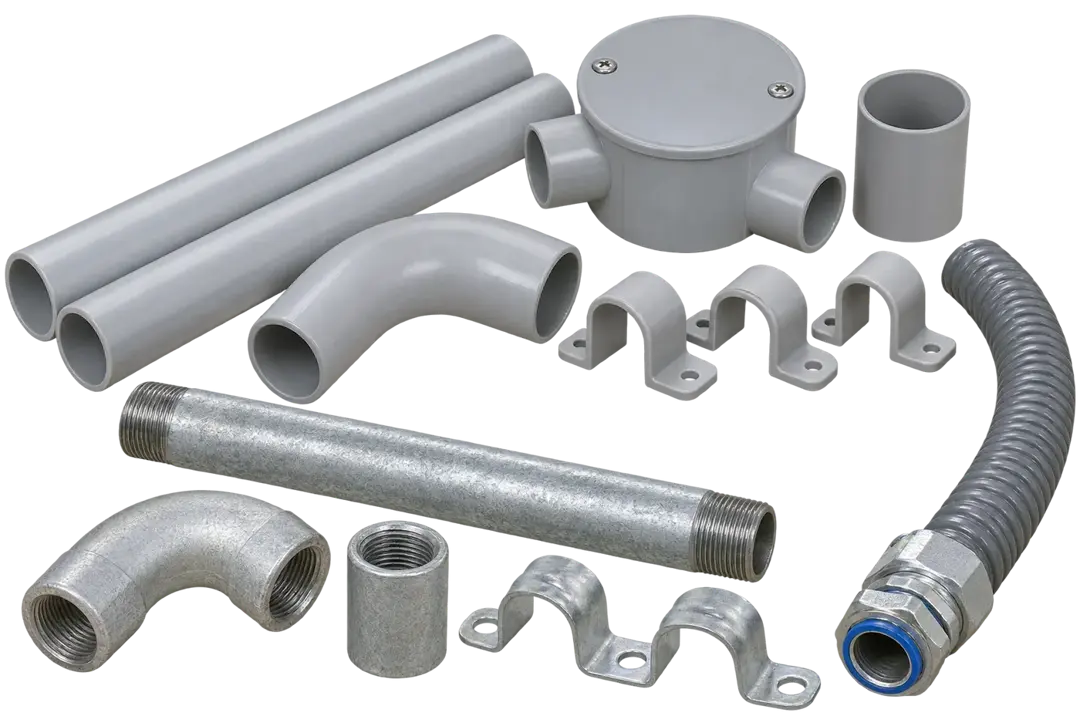
Wherever PV cables leave the shade of the modules — crossing roofs, running down façades or entering buildings — they need mechanical and UV protection. Heavy-gauge PVC conduit to IEC 61386 with UV stabilisers is light, does not corrode and is easy to cut and solvent-weld; in the Gulf sun specify a UV-rated grade, not standard grey indoor conduit, which chalks and cracks. Hot-dip galvanised steel conduit is preferred where impact, fire separation or rodent damage is a concern, and inside plant rooms.
The kit covers a typical residential or small commercial installation: 20–32 mm conduit lengths, couplers, 90° elbows and inspection bends, tees, spacer-bar saddles, male adaptors, glands for box entry and expansion couplers. PVC expands roughly 0.07 mm per metre per °C, so a 30 m roof run can grow by more than 100 mm between a winter morning and a summer afternoon — fit an expansion coupler every 6–8 m and fix saddles without over-tightening. Keep DC and AC circuits in separate conduits and fill to no more than about 40 % of the cross-section.

Double-insulated, UV- and ozone-resistant tinned-copper PV cable rated 1500 V DC, the standard choice for string runs on commercial and utility arrays.

The cross-section used on module leads and short rooftop string runs; 1500 V DC, halogen-free, UV-resistant.
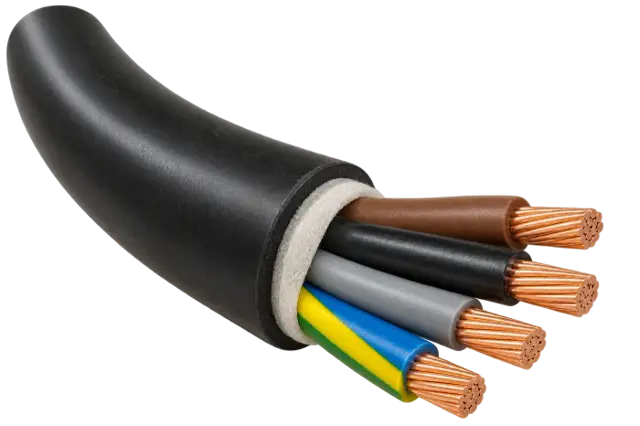
0.6/1 kV copper XLPE-insulated, PVC-sheathed (armored on request) cable linking inverters to the AC distribution board, priced as a representative 5-core 10 mm².
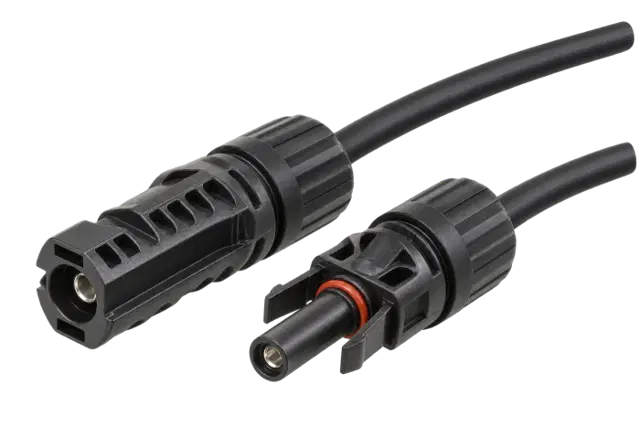
Male + female IP68 PV connectors for 4–6 mm² cable, 1500 V DC, certified to IEC 62852.
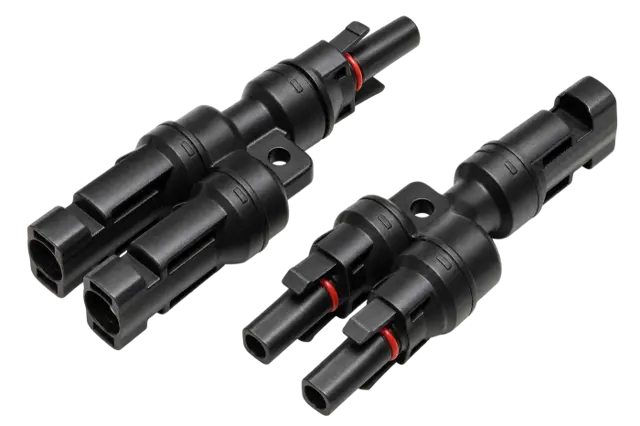
Parallels two strings onto one MPPT input or cable: one male (+) and one female (−) branch, 1500 V.

Ratchet crimper with 2.5/4/6 mm² dies, insertion tool, unlocking wrenches and cable stripper.

IP65 enclosure with gPV string fuses, Type 2 DC surge protection and a load-break isolator, 1000/1500 V DC.
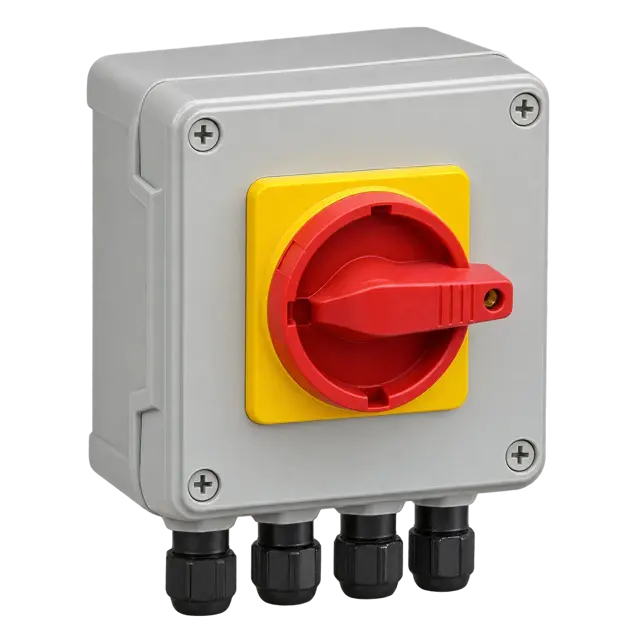
Rotary load-break DC switch in an IP66 enclosure for safely isolating strings ahead of the inverter.
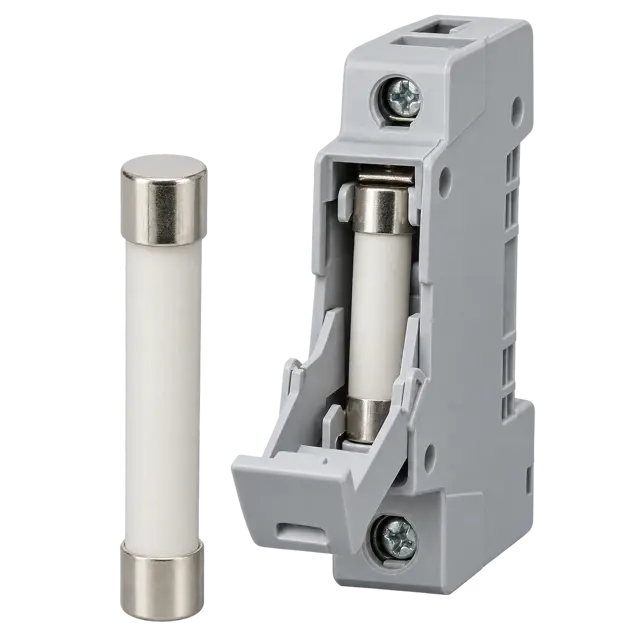
10×85 mm photovoltaic fuse link (15–32 A) with DIN-rail fuse holder, rated to IEC 60269-6.
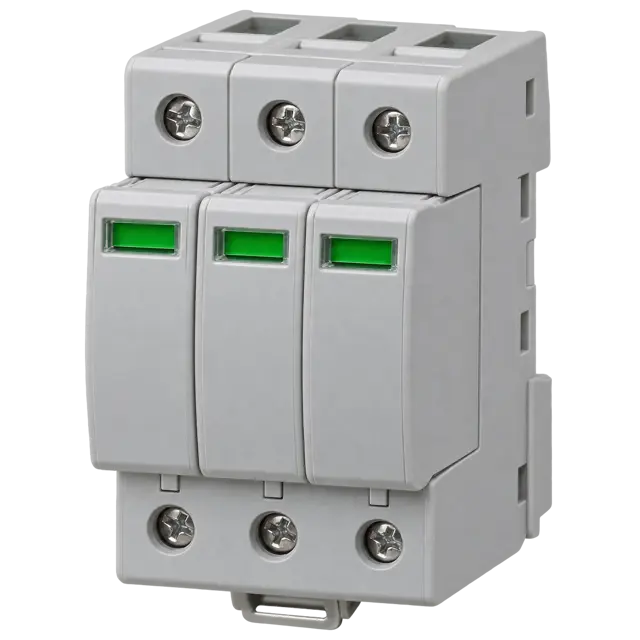
Y-configured MOV surge arrester with thermal disconnect and pluggable modules (In 20 kA, Imax 40 kA) for PV strings.
