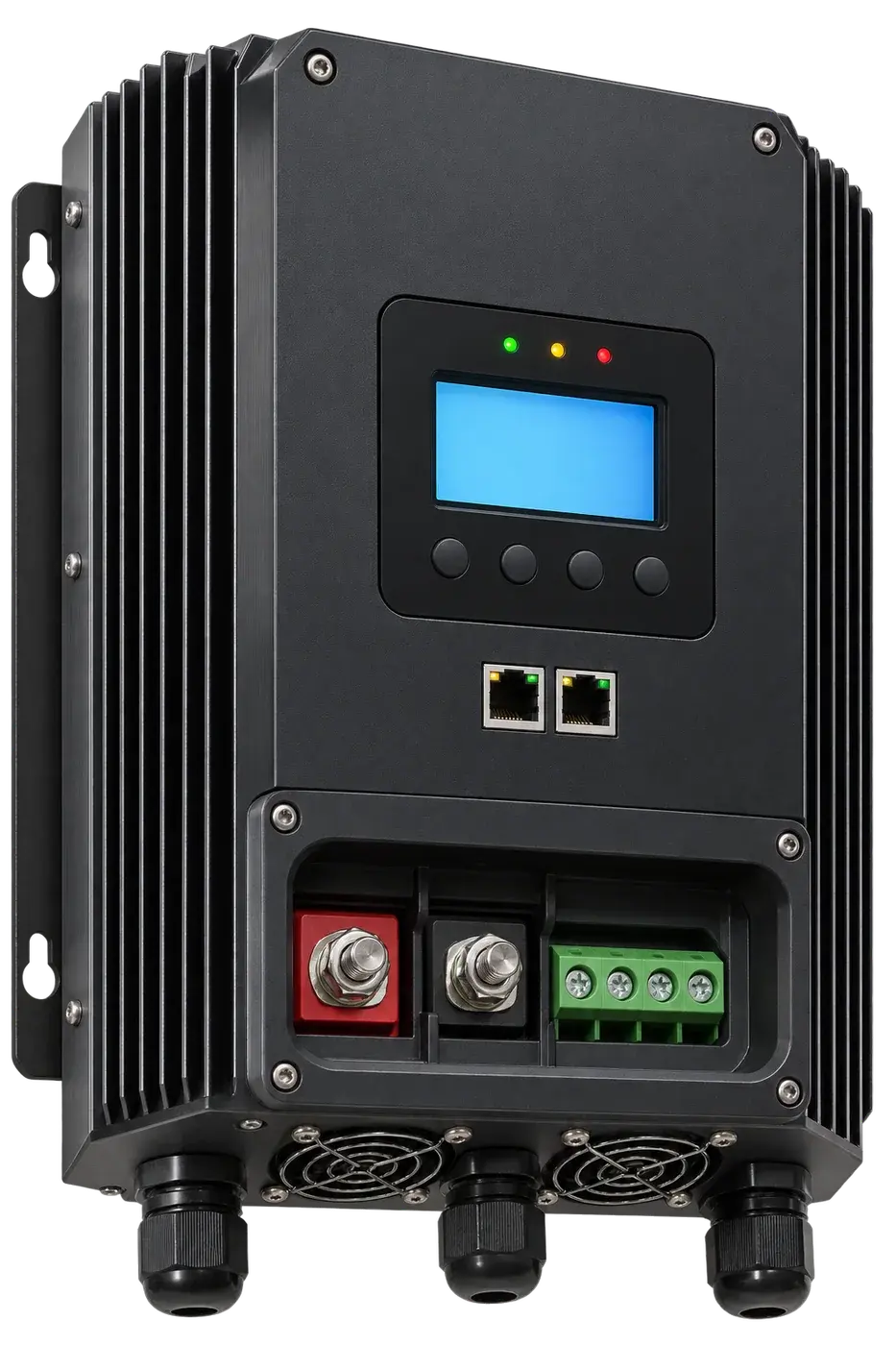
At 48 V and 100 A, this controller handles about 5.8 kW of charging power (100 A × 58 V absorption), making it the building block for DC-coupled off-grid plants and telecom sites. Several units can run in parallel on one battery bank, synchronising their charge stages over a data bus, so a 20 kWp array can be split across four controllers with the inverter-charger handling AC loads separately — a robust architecture, because the loss of one controller only reduces charging capacity.
The 250 V PV limit allows four modern 72-cell modules in series (about 4 × 50 V = 200 V at STC, roughly 210 V at a 10 °C winter morning) with a safe margin, or five 60-cell modules. Higher string voltage keeps PV current near 13–18 A, so 6 mm² cable covers long runs from a ground array to the battery room.
Features to expect: programmable charge algorithm with LFP profiles and BMS-controlled charge current, a relay for generator start or load shedding, data logging of 30+ days, and Modbus/CAN or Ethernet monitoring. Use a DC isolator rated for 250 V DC on the PV input, a class T or NH fuse on the battery side, and keep the unit out of direct sun — full current output is typically guaranteed only up to 40 °C ambient.
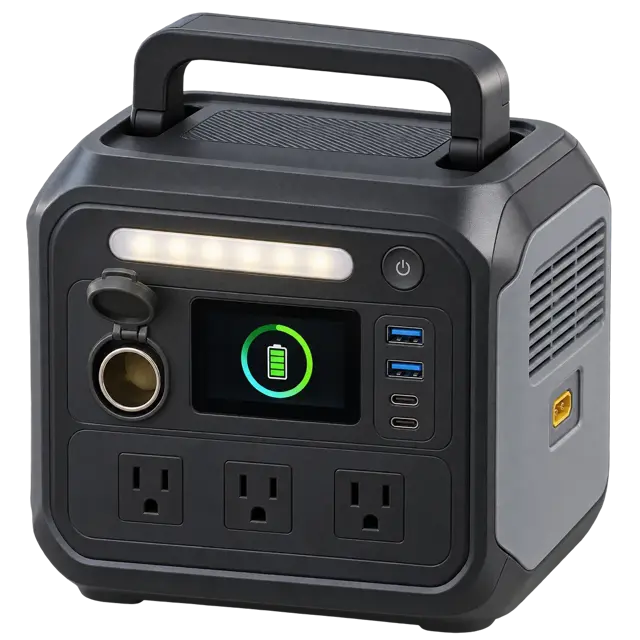
All-in-one battery, MPPT solar charger and pure-sine inverter in a carry case. Good for camping, site tools, mobile work and keeping essentials running at home.
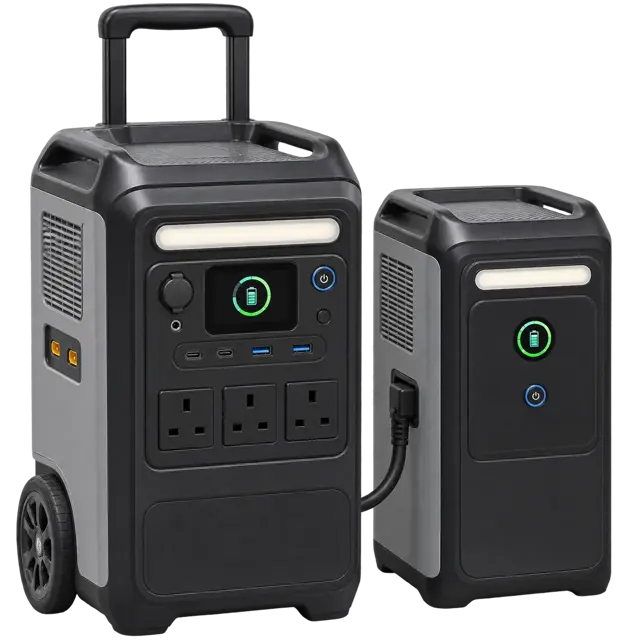
Wheeled LFP power unit with 3.6 kW inverter, dual MPPT inputs and add-on battery packs up to about 20 kWh: home backup with no installer needed.
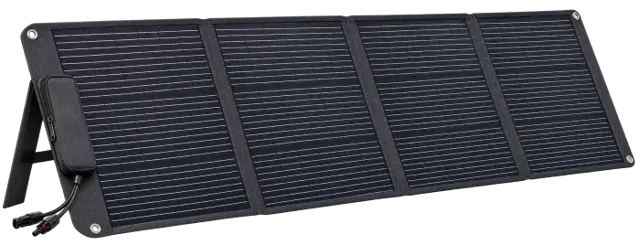
ETFE-laminated monocrystalline panel that folds into a briefcase with kickstands. Connects to power stations through an MC4 or XT60 adaptor.
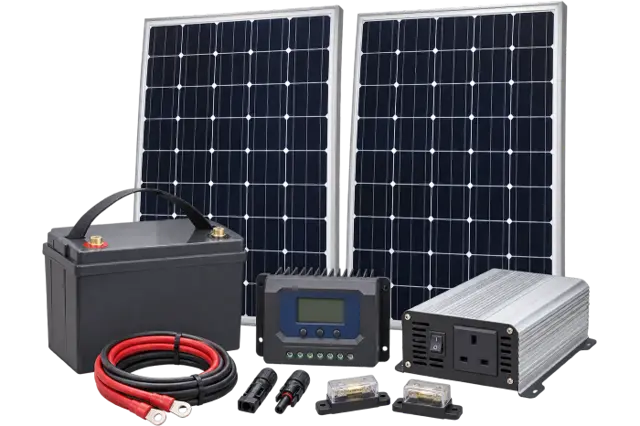
Complete small system for cabins, kiosks, campers and farm huts: 2 × 200 W panels, 30 A MPPT, 12.8 V 100 Ah LFP battery, 1 kW pure-sine inverter, cables and fuses.
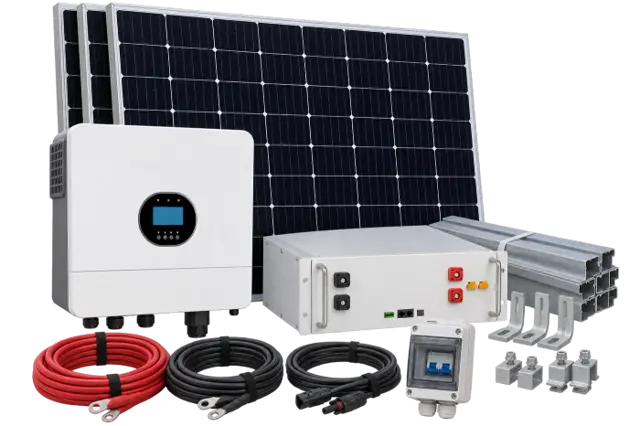
Cabin, farm or remote-site package: 1.5 kWp of modules, an all-in-one 3 kW inverter with built-in MPPT and charger, 25.6 V 200 Ah LFP, mounting and wiring.
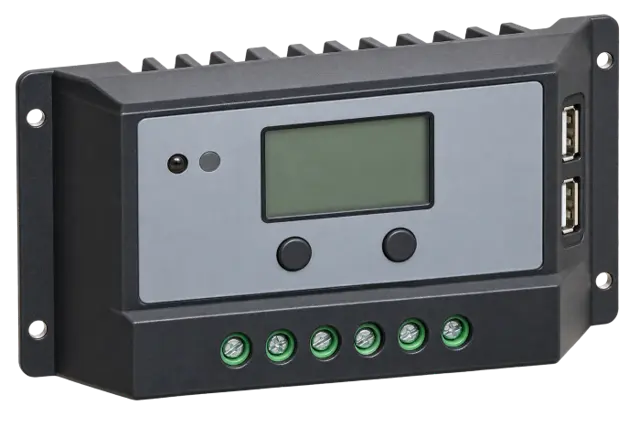
Low-cost controller for small 12/24 V systems with panels matched to battery voltage; LCD, USB outputs and selectable lead-acid or lithium profiles.

Tracks the panel's maximum power point and converts excess voltage into charging current. Handles up to 3.2 kW of PV at 48 V, with Bluetooth monitoring and lithium profiles.
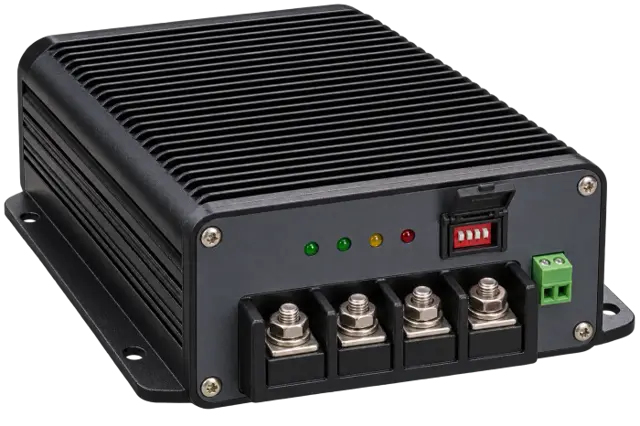
Charges a vehicle or boat house battery from the alternator and roof panels at the same time, with the correct lithium profile and starter-battery protection.
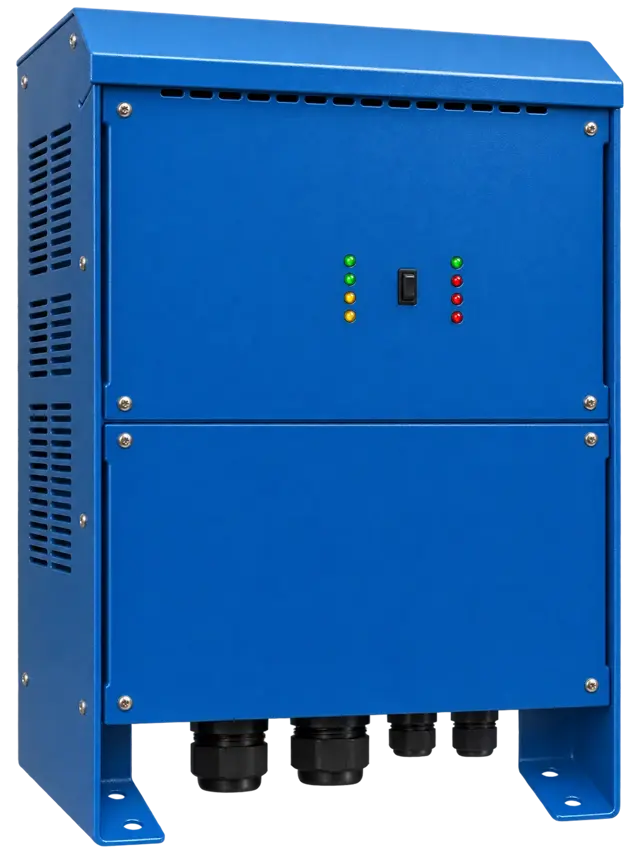
Transformer-based inverter with 3× surge capacity for motors, pumps and compressors, a built-in battery charger and automatic transfer from grid or generator.
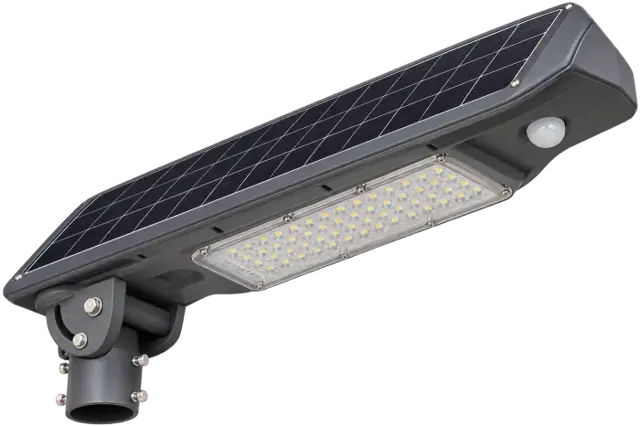
Panel, LFP battery, controller, LED head and motion sensor in one housing for 6–8 m poles. Lights roads, compounds and car parks with no trenching or grid connection.
