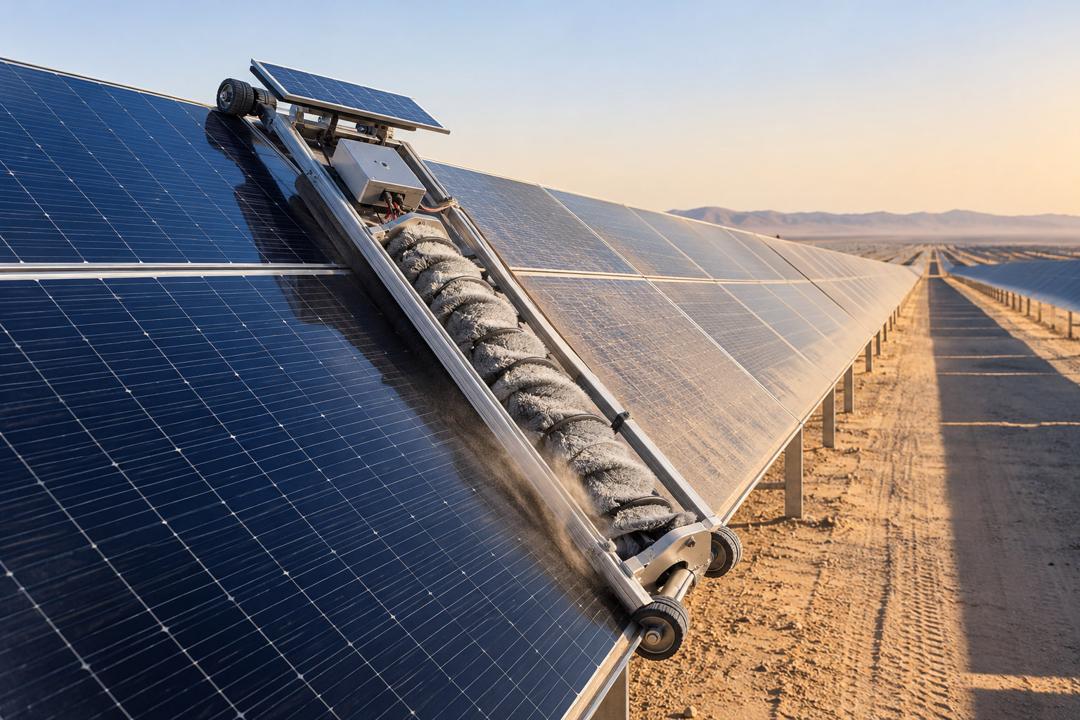
Soiling is the single largest controllable loss in Gulf and desert climates. Without cleaning, a module in the UAE or Saudi Arabia can lose 0.3–1 % of output per day, and a single sandstorm can cut production by 10–20 % overnight. Manual washing with tankers is slow, labor-intensive and uses scarce water, roughly 1–2 liters per module per wash.
Row robots address this. Each robot travels along one table on its own rails or directly on the module frames, sweeping the glass with a rotating microfiber brush and airflow. It parks in a docking station at the end of the row, recharges from its own small PV module and battery, and is controlled by a central system that schedules runs at night or right after a dust event. Cleaning can run daily without water, field crews or staff working on the modules.
Selection points: compatibility with the module size and frame (e.g. 2384 × 1303 mm, 33 mm frame), table length (typically up to 120 m per robot), ability to transfer between rows on trackers, brush material approved by the module manufacturer so the anti-reflective coating and warranty are preserved, and IP65+ protection against sand ingress. Typical soiling-loss reduction is from 5–8 % to under 1 % annually, which usually repays the robots within 2–4 years.
Price shown is per robot covering one row (≈ 100–250 kWp depending on layout); docking, transfer carts and the control system are quoted per project.
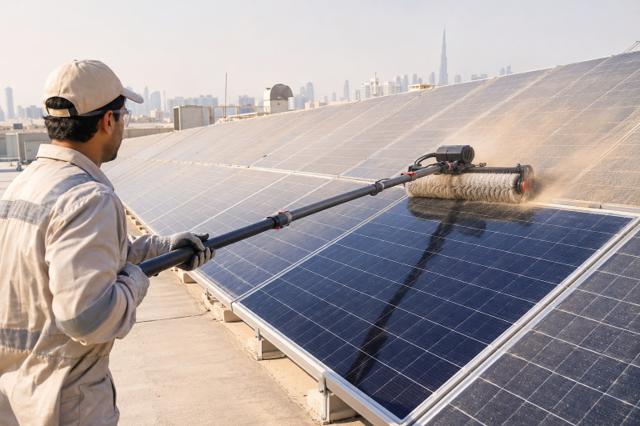
Battery-powered rotating brush on a telescopic pole for rooftops and small plants; optional water connection.
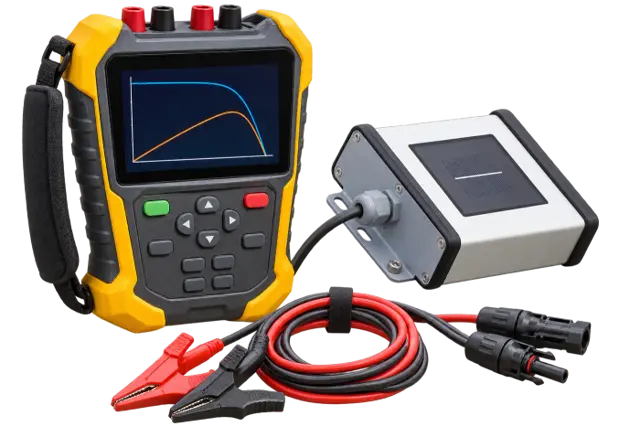
Field instrument that measures the full current-voltage curve of a string and compares it with the datasheet at STC.

Aerial infrared survey that detects hot spots, failed diodes, disconnected strings and cracked modules across an entire plant in hours.

CAT III 1500 V kit: insulation resistance, Voc, Isc, polarity, earth continuity and DC clamp current for commissioning and fault-finding.

Arc-rated clothing, face shield, insulated gloves and safety footwear for work on live PV DC and LV AC equipment.
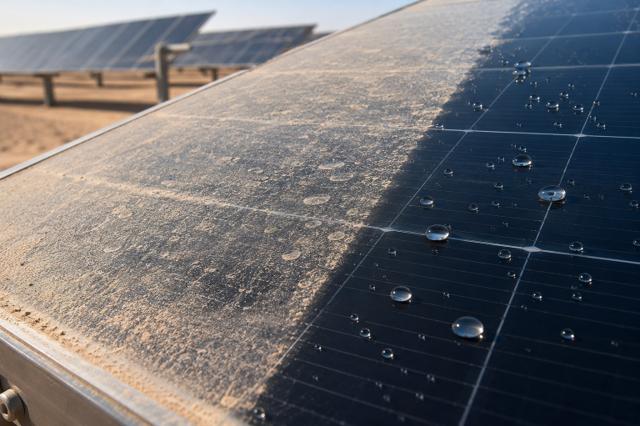
Optional nano-coating applied on site that reduces dust adhesion and makes cleaning easier; lasts 1–3 years.
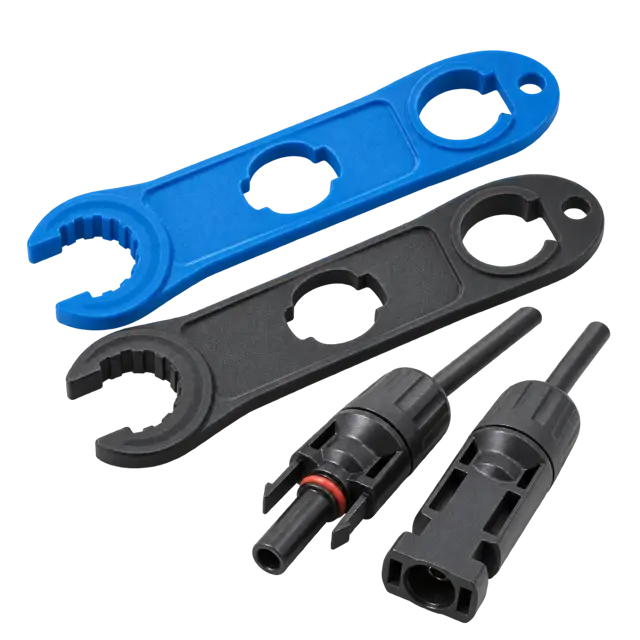
Pair of glass-fibre reinforced spanners for tightening MC4 cable glands and releasing the locking latches without damaging the housing.

Pocket meter reading plane-of-array irradiance in W/m² and module back-sheet temperature — the quick reference for commissioning and performance checks.
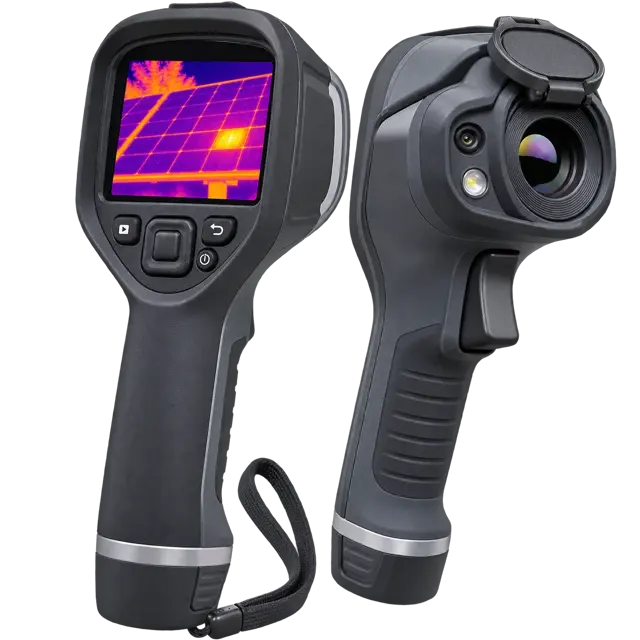
Radiometric infrared camera for finding hot cells, failed bypass diodes, loose terminals and overheated fuses in modules, combiner boxes and switchboards.

Measures earth electrode resistance and soil resistivity with stakes, plus stakeless clamp testing of individual rods in a meshed earthing system.
