How bifacial modules harvest reflected light, what albedo values to expect on sand, gravel and white membranes, and why bifacial pairs so well with trackers.
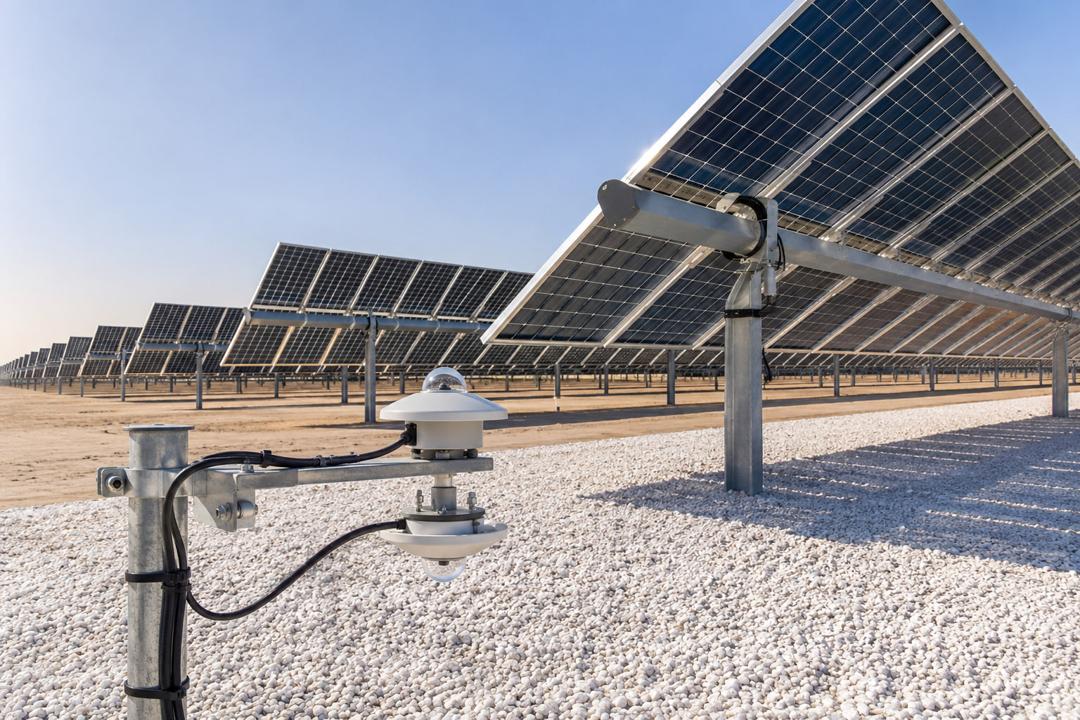
A bifacial module has transparent glass (or a clear backsheet) on its rear side, so its cells also convert light that reaches the back: light reflected from the ground and scattered from the sky. Bifaciality is the ratio of rear-side to front-side efficiency under the same irradiance: about 70 % for bifacial PERC, 80 ± 5 % for N-type TOPCon (for example the Jinko Tiger Neo series) and up to 85–95 % for HJT.
The extra energy, called bifacial gain, depends above all on albedo, the fraction of light the ground reflects. Typical values: green grass 0.15–0.25, desert sand 0.25–0.40, light gravel 0.25–0.35, fresh concrete about 0.3, white roofing membrane 0.6–0.8 and fresh snow up to 0.9. In the Gulf, bright sand gives realistic bifacial gains of about 5–15 % over an equivalent monofacial module, depending on mounting height and row spacing.
Geometry matters as much as ground color. Raising the lower edge of the modules (1–2 m above ground), widening the row pitch (lower ground coverage ratio) and avoiding structural parts directly behind the cells all increase the light reaching the rear. Module layouts in portrait with two modules high ('2P') create more self-shading on the back than one-in-portrait ('1P') trackers, which is one reason 1P trackers dominate bifacial utility projects.
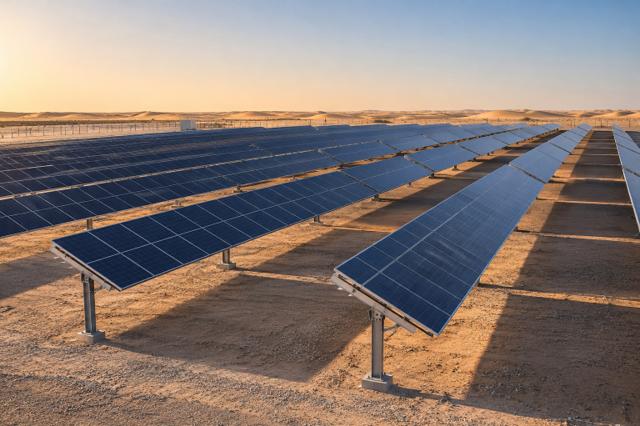
Bifacial modules and single-axis trackers are a natural pair: the tracker keeps the front face pointed at the sun while the high, open structure lets reflected light reach the rear, and the rows are usually widely spaced. Combined gains of 25–35 % over fixed monofacial systems are common in desert sites, which is why nearly all new utility-scale projects in the GCC specify bifacial N-type modules on trackers. When modeling yield, use conservative albedo values and account for soiling on the rear side as well.
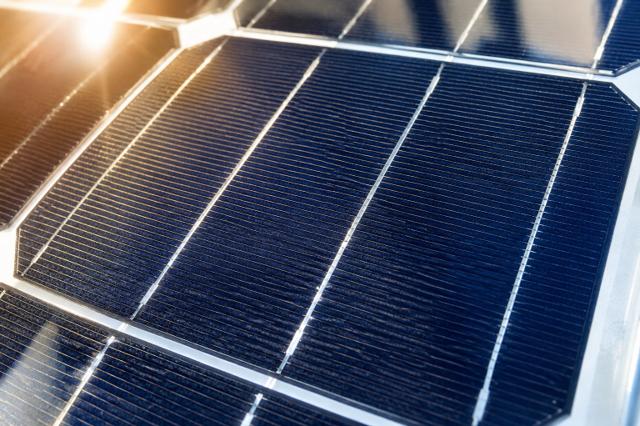
From photon to kilowatt-hour: the physics of a solar cell and the path of energy through a complete PV system.
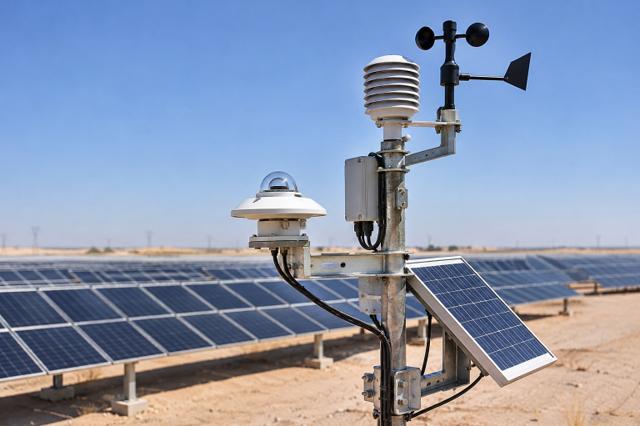
GHI, DNI and DHI explained, how sun position changes through the day and year, and why the Gulf is one of the world's best solar resources.
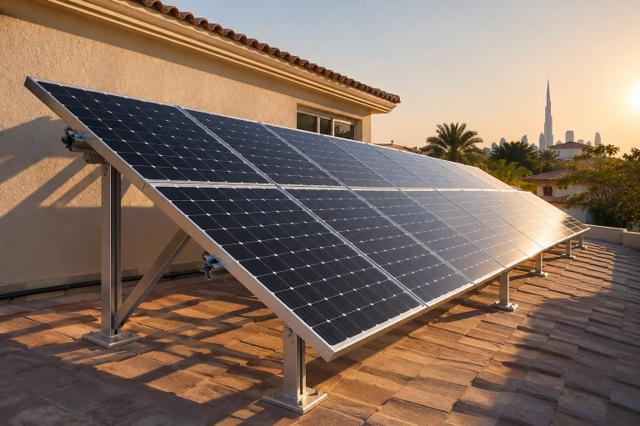
How to orient a PV array: the latitude rule of thumb, why lower tilts often win in the Gulf, and how east–west layouts trade yield for density.
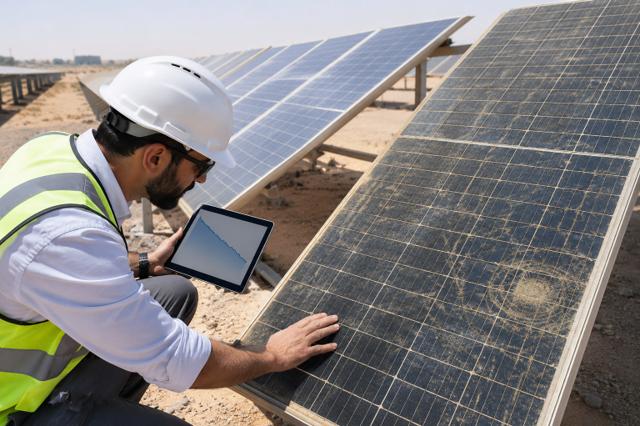
LID, LeTID and long-term power loss explained, and how to read a 12-year product / 30-year linear power warranty.
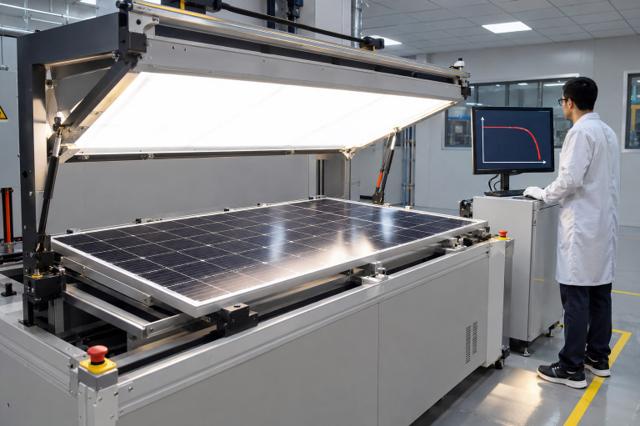
What the datasheet power really means, how temperature coefficients translate into lost watts, and why heat is the main derating factor in the desert.
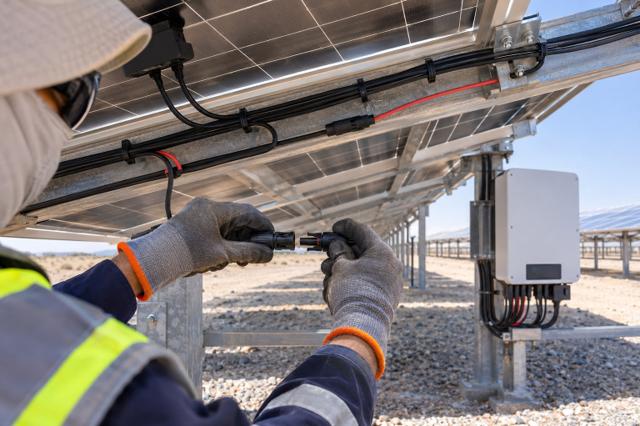
How many modules can go in one string: the cold-temperature Voc limit, the MPPT window and current limits, with a worked 1,500 V example.
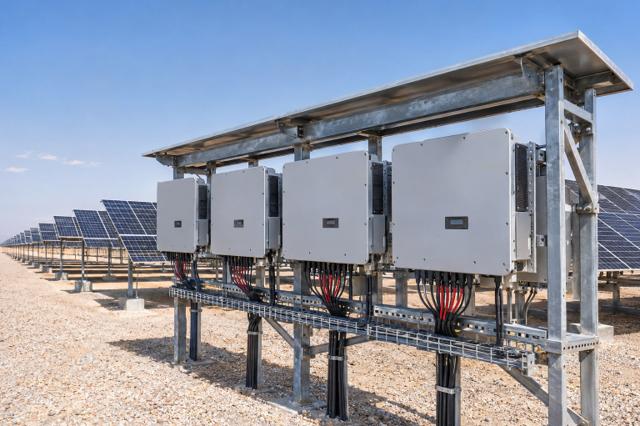
Why PV plants are built with more module power than inverter power, and how to choose a DC/AC ratio between 1.1 and 1.35 without losing too much energy to clipping.
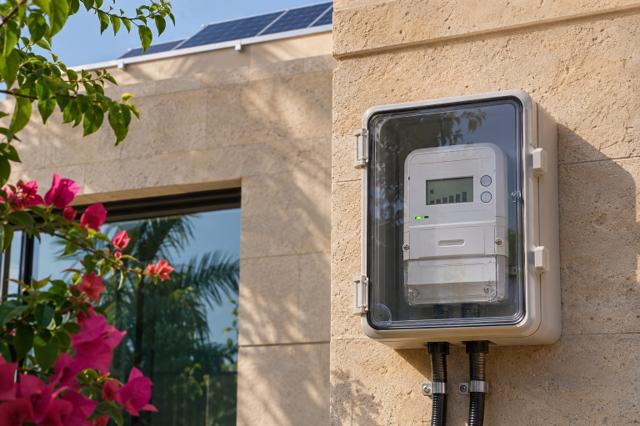
How grid-connected rooftop systems are credited for the electricity they export, and how the tariff scheme changes the right system size and the payback period.

The single number used to compare power plants: lifetime cost divided by lifetime energy, both discounted. What drives it, and why Gulf solar tariffs are among the lowest in the world.
How shadows reduce PV output far more than their size suggests, how to set row pitch with the ground coverage ratio and the winter-solstice rule, and how bypass diodes and half-cut cells limit the damage.
