How to orient a PV array: the latitude rule of thumb, why lower tilts often win in the Gulf, and how east–west layouts trade yield for density.
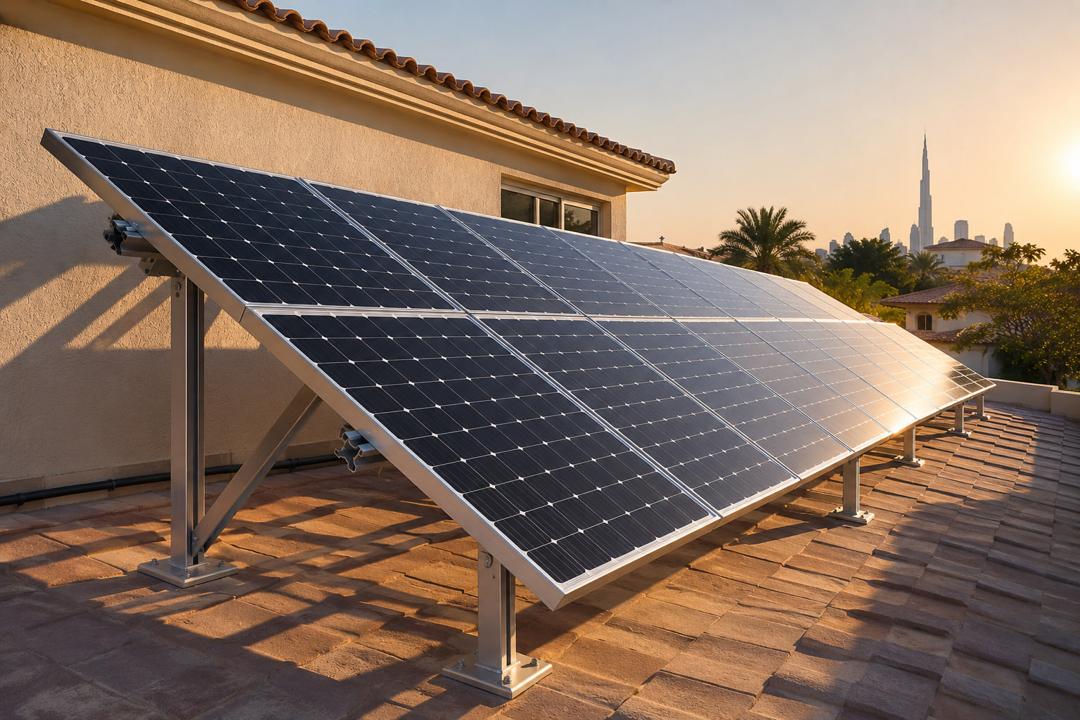
Tilt is the angle between the module surface and the horizontal; azimuth is the compass direction the modules face. To capture the most energy over a year, a fixed array in the Northern Hemisphere should face true south (azimuth 180°), and one in the Southern Hemisphere true north. Deviations of up to ±30° from the ideal azimuth typically cost only a few percent of annual yield, which gives architects useful freedom on rooftops.
The classic rule of thumb is: optimal annual tilt ≈ site latitude. In practice, the optimum is usually a little lower than latitude, because summer days are longer and contribute more energy, and because diffuse light favors flatter surfaces. For the UAE (latitude 22–26° N), fixed systems are commonly designed at 20–25°; carports and rooftops often use 5–15° for wind loading, drainage and aesthetics with only a small loss.
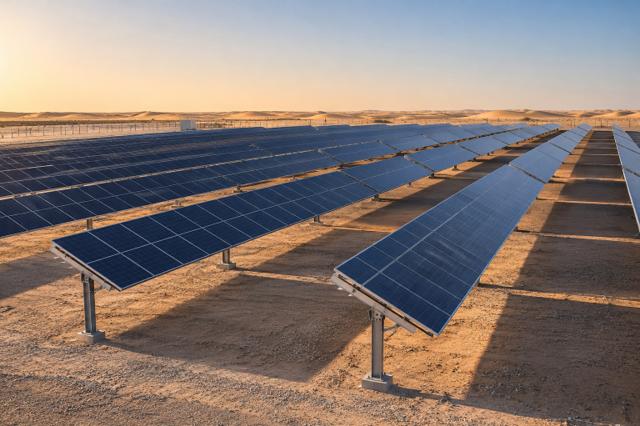
Tilt also governs soiling and row spacing. Very flat modules (below about 10°) shed dust and rainwater poorly, which matters in desert climates. Steeper modules cast longer shadows, so rows must be spaced further apart, reducing the number of kWp per hectare. Utility designers therefore optimize tilt and ground coverage ratio (GCR) together, often accepting a slightly lower tilt to fit more capacity onto the land.
East–west layouts, with pairs of modules at 10–15° facing opposite directions, produce roughly 8–12 % less energy per kWp than an ideal south-facing array but fit far more modules onto a flat roof, flatten the daily production curve and reduce wind loads. On single-axis trackers, tilt and azimuth are replaced by a north–south rotation axis that follows the sun from east to west, adding typically 15–25 % energy in the Gulf compared with fixed tilt.

From photon to kilowatt-hour: the physics of a solar cell and the path of energy through a complete PV system.
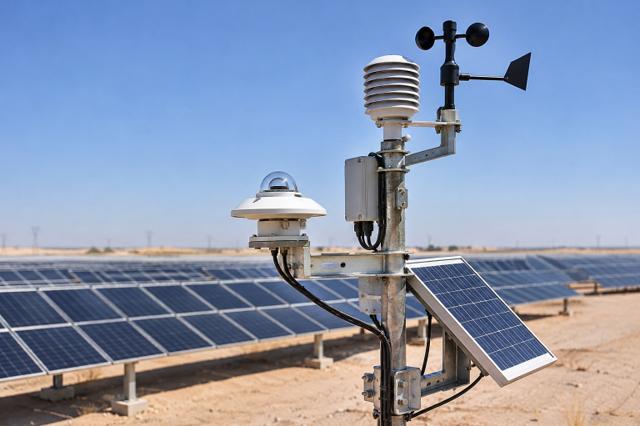
GHI, DNI and DHI explained, how sun position changes through the day and year, and why the Gulf is one of the world's best solar resources.
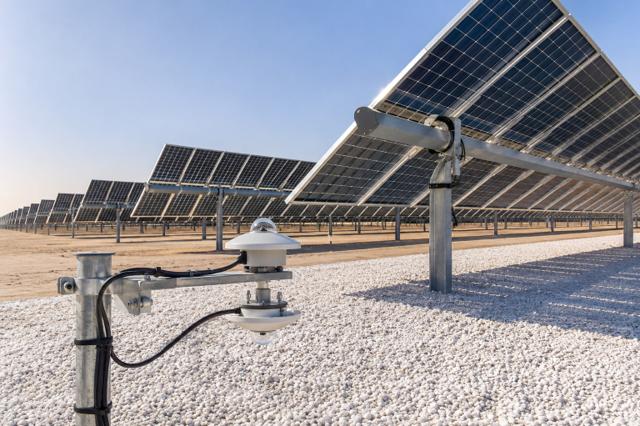
How bifacial modules harvest reflected light, what albedo values to expect on sand, gravel and white membranes, and why bifacial pairs so well with trackers.
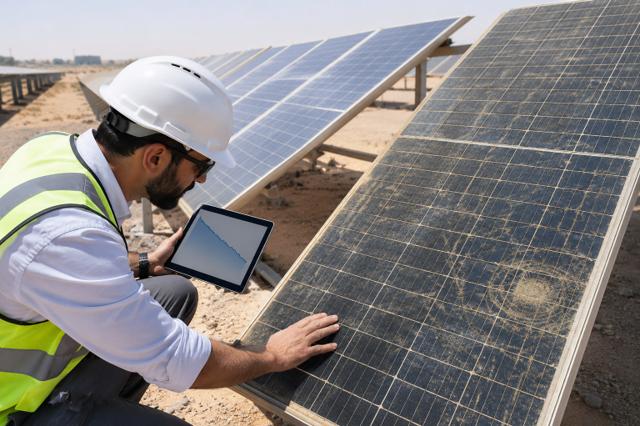
LID, LeTID and long-term power loss explained, and how to read a 12-year product / 30-year linear power warranty.
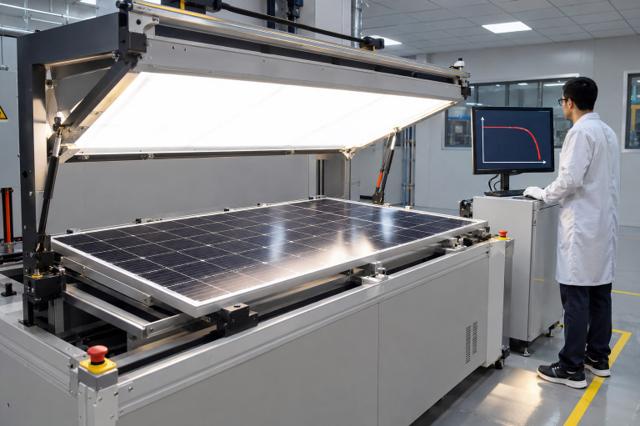
What the datasheet power really means, how temperature coefficients translate into lost watts, and why heat is the main derating factor in the desert.
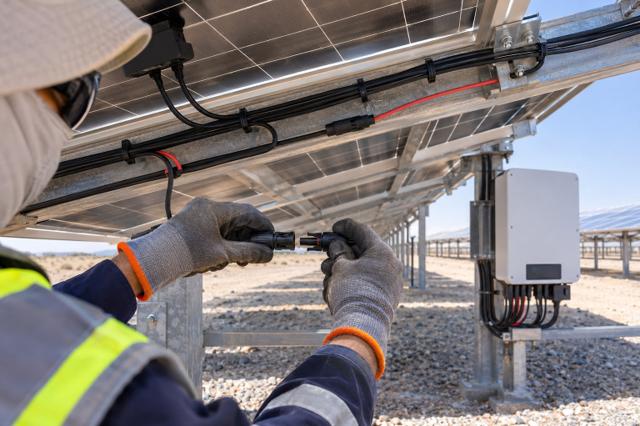
How many modules can go in one string: the cold-temperature Voc limit, the MPPT window and current limits, with a worked 1,500 V example.
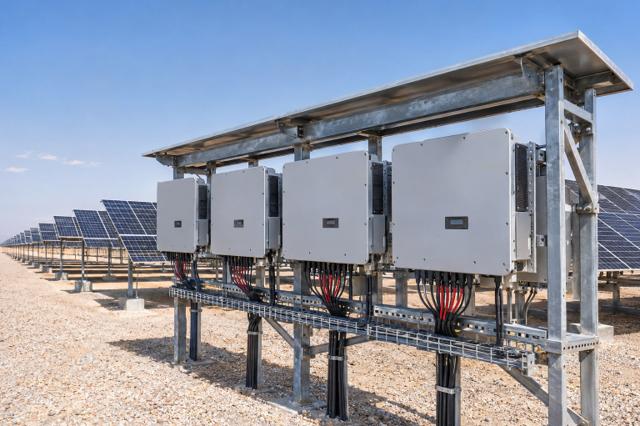
Why PV plants are built with more module power than inverter power, and how to choose a DC/AC ratio between 1.1 and 1.35 without losing too much energy to clipping.
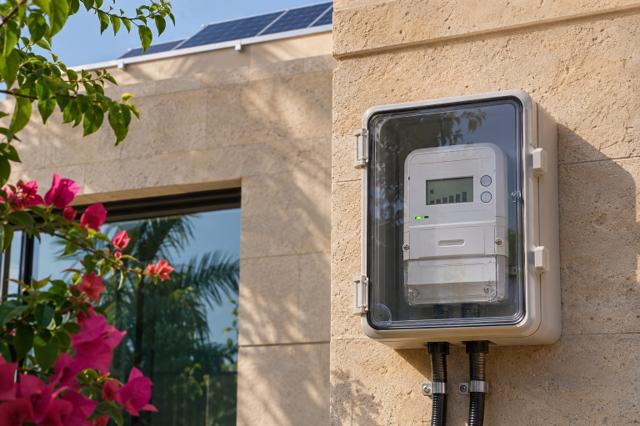
How grid-connected rooftop systems are credited for the electricity they export, and how the tariff scheme changes the right system size and the payback period.

The single number used to compare power plants: lifetime cost divided by lifetime energy, both discounted. What drives it, and why Gulf solar tariffs are among the lowest in the world.
How shadows reduce PV output far more than their size suggests, how to set row pitch with the ground coverage ratio and the winter-solstice rule, and how bypass diodes and half-cut cells limit the damage.
